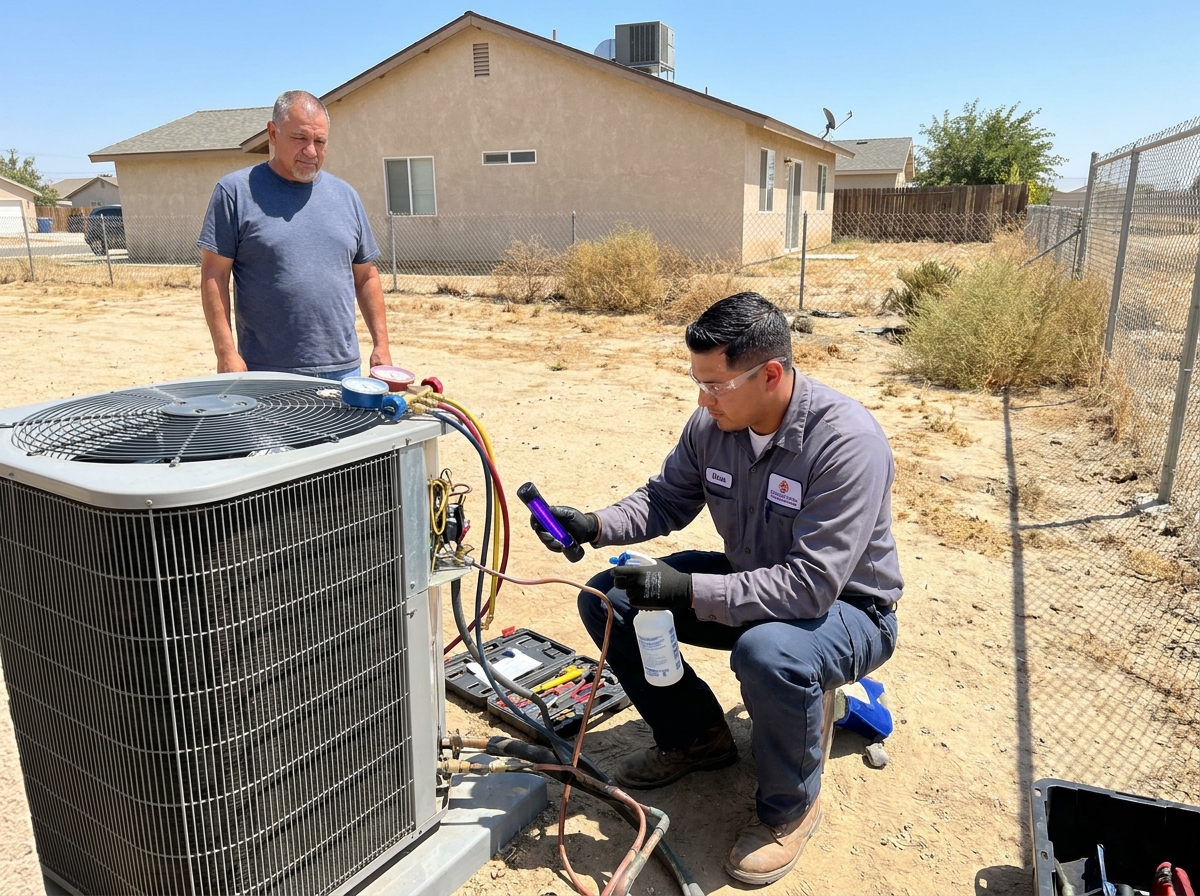
Bakersfield’s hot desert summers push air conditioners to run longer and harder than in coastal regions, making even small refrigerant leaks noticeable within days. Older housing stock in Oildale and parts of Downtown Bakersfield often still carries original copper lines and R-22 equipment that has endured decades of 100-plus-degree days and nightly temperature drops. Technicians must pressure-test both high and low sides, then use electronic sniffers and UV dye because heat-expanded joints and vibration from rooftop units common on flat-roof homes here frequently hide leaks behind fascia or in attic returns.
When a leak is confirmed, recovery of remaining refrigerant is required before any brazing or component replacement. In neighborhoods such as Stockdale and Rosedale, many 1990s–2000s homes have packaged units where the evaporator coil sits directly above the furnace; moisture from the drain pan can corrode the coil bottom, so simply topping off without addressing the root cause leads to repeat visits. Technicians carry both R-410A and legacy R-22 cylinders on the truck because conversions remain common when the leak is in a 20-plus-year-old coil that can no longer be sourced.
Refrigerant Leak Repair Near You — Choose Your City
Every city below has its own local Refrigerant Leak Repair page with coverage details.
Code compliance in Kern County requires proper recovery documentation and leak-rate calculations for systems over 50 pounds; homeowners in Taft or Wasco who run commercial-sized units on small farms sometimes overlook this step. After repair, the system is evacuated to 500 microns, held, then recharged by weight according to the data plate—never by pressure alone—because the extreme ambient temperatures here make superheat and subcooling readings shift quickly once the unit cycles off.
Technician insight
In Bakersfield, the thing that catches most people out with Refrigerant Leak Repair is how quickly a pinhole leak in a 1990s copper line set turns into a full system failure once June temperatures hit 105. Homes in Oildale with original lines running across hot attics expand and contract every day, so a joint that held all winter blows out fast; skipping the full evacuation after repair just guarantees another call before Labor Day.
Rooftop Leak on Rosedale Home
A 22-year-old packaged unit on a Rosedale residence was short-cycling during a 108-degree afternoon. Pressure testing revealed a leak at the suction-line elbow where vibration had worn the copper against the frame. The line was cut back, a new fitting brazed in, the system recovered, evacuated, and recharged; the homeowners reported steady 72-degree indoor temperatures the next day.
Refrigerant Leak Repair Services We Offer
✓Residential Refrigerant Leak Detection
Electronic and UV-dye inspection of split systems and packaged units serving single-family homes in Stockdale and Rosedale.
✓Evaporator Coil Leak Repair
Targeted repair or replacement of leaking indoor coils common in 1990s homes throughout Oildale and Downtown Bakersfield.
✓R-22 System Leak Sealing
Pressure testing and brazed repairs on older R-22 equipment still operating in Kern County neighborhoods.
✓Commercial Rooftop Leak Repair
Leak location and component replacement on packaged rooftop units serving businesses near California Living Museum and Buck Owens Crystal Palace.
✓Condenser Coil Leak Repair
Repair of outdoor coil leaks caused by hail, vibration, and salt-air exposure on units serving properties in Wasco and Delano.
Refrigerant Leak Repair Cost in California
| Service | Typical Range | What Affects It |
|---|---|---|
| Leak detection and diagnosis | $150–$350 | Varies by number of zones and attic or rooftop access in Stockdale or Oildale homes. |
| Evaporator coil leak repair | $450–$900 | Includes recovery, brazing or coil replacement, and recharge; higher when coil is in tight attic space. |
| Condenser coil repair or replacement | $600–$1,400 | Depends on unit size and whether hail-damaged fins require full coil swap after summer storms. |
| Full R-22 to R-410A conversion | $1,800–$3,200 | Required when leak occurs in obsolete equipment; common in 25-year-old homes near Kern County Museum. |
Ranges are typical for California and confirmed with an exact written quote before any work starts.
How it works
- 1
Initial Pressure Test
Technician isolates the system and performs nitrogen pressure test to locate the general leak zone without releasing refrigerant.
- 2
Electronic and UV Inspection
Electronic sniffer and UV dye pinpoint the exact leak site on coils, lines, or fittings common in Bakersfield’s older housing.
- 3
Recovery and Repair
Remaining refrigerant is recovered, the leak is brazed or the component replaced, then the system is reassembled.
- 4
Evacuation and Recharge
Deep vacuum to 500 microns is pulled, held, and the correct refrigerant weight is added per manufacturer specifications.
Pricing
Upfront quote provided after on-site leak inspection; final price depends on access, refrigerant type, and parts needed.